

Every one of the 70 levels is proven solvable, not merely likely to be. A solver built into the pipeline checks every generated board in full: if it cannot clear it completely, the board is discarded. Across the whole development, this process rejected 69,920 boards before 70 remained — an average of 999 attempts per kept level, a median of 332. The hardest level cost 6,684 discarded boards before one passed; the easiest succeeded on the first try. Together, all 70 boards carry 1,317 pieces, and their proven solutions together take 370 moves.
Quiet Gravity · Workshop notes
Behind the App
Quiet Gravity is a small game that took more computing time than it lets on, and a few honest detours along the way.
- Boards discarded
- 69,920before 70 proven-solvable ones remained
- Per kept level
- 999on average; a median of 332
- Most for one level
- 6,684the easiest succeeded on the first try
Counted on 22 September 2026 from the shipped level data and the working tree. Not rounded.
The boards
How the 70 levels came about
The marbles
Why the marbles took some thirty versions
The marbles you play with had the longest road of all. Roughly thirty versions were built and discarded before one was settled on — glass thickness, refraction, rim shading, an inner reflection. In fairness, that round of work had no fixed endpoint at first. It stopped when a version was chosen, not because a criterion had been met.
The marks
Why colour never decides on its own
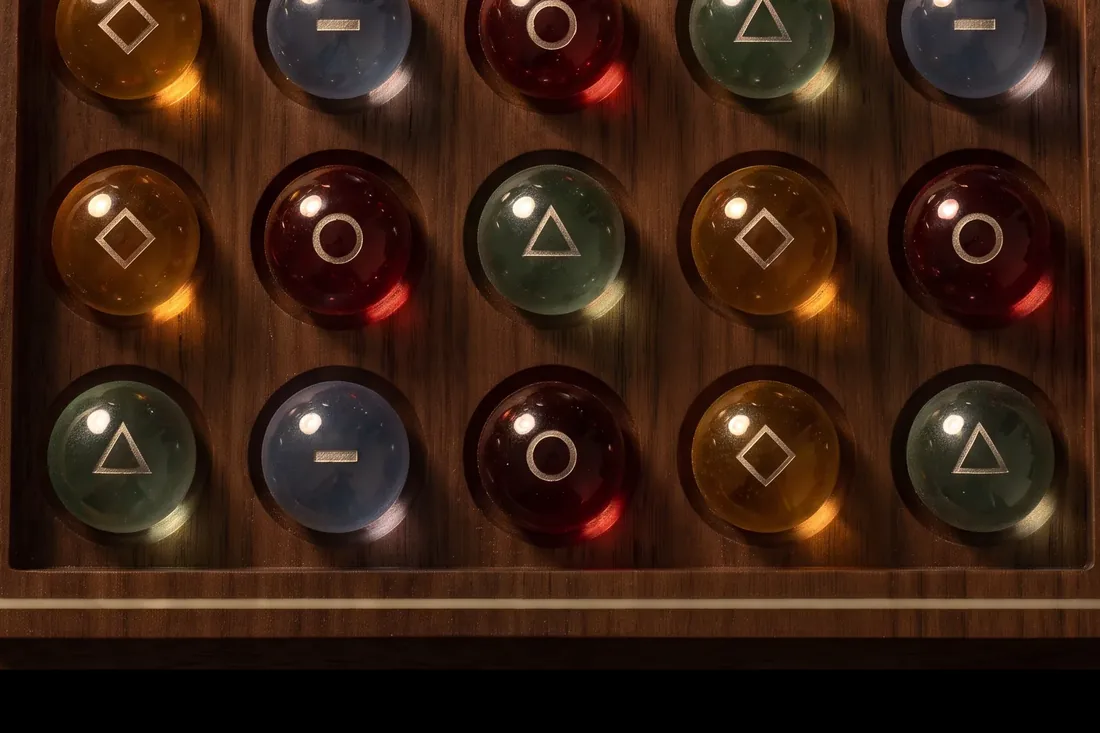
So that colour never carries the only information, each of the four colours also has its own embossed mark: circle, diamond, triangle, bar. Anyone who cannot tell colours apart well, or at all, can still tell the marbles apart.
The sound
Why the sound is recorded, not generated
The sound is recorded, not computed. Glass on glass, glass on wood, a marble dropping into a hollow — recorded by hand, then trimmed and measured. Across all seventy levels that comes to 5,060 sounds from recordings against 640 from a model.
The reason was a wrong note. Everything used to be computed, and the model behind it describes a struck bar. A glass marble does not vibrate like a bar — it sounds dense and inharmonic, and a marble on wood does not vibrate at all; it is a short, broadband knock. The result sounded like a xylophone. Not a bug in the code: the wrong material in the model.
Two sounds are still computed, and they are exactly the two the bar model gets right — the board tilting, and the board settling again. That is wood, not glass.
What that means, and what it doesn’t
None of this makes any single level easier or harder. It only describes what sits behind a board that looks as though it were simply there.